Transfer of power to State poses threat to environment

This might be a good news for Santos, Chevron, Woodside, Shell, BHP Billiton, ExxonMobil, Origin, Ta Ann—name it—and all those other giants engaged in the business of “exploiting” Australia’s natural resources. They will have more freedom to dig and rig, build dams, or haul native logs—if the power to enforce environmental laws will be transferred from the Federal Government to the State Government.

Undated photo shows BHP Billiton running this machine at Mt Newman mine in Western Australia. (AP Photo/BHP Billiton,HO)

The Council of Australian Governments earlier this year agreed to reform controversial environmental laws. It proposes changes that would give states autonomy to take control over local environmental laws.

The Environment Protection and Biodiversity Conservation Act 1999 (EPBC Act)  administered by the Department of the Environment, Water, Heritage and the Arts covers the assessment and approval process of national environmental and cultural concerns. It also administers specific Acts that oversee activities relating to marine resources, importing, heritage issues, hazardous waste, and fuel quality.

State and territory environment laws apply to specific business activities and are administered by both state and local governments in the form of licences and permits.

The plan to hand over control of national environmental powers to state and territory governments has outraged the Greens. Last month, an alliance of more than 35 environmental organisations sent more than 10,000 petition signatures to Environment Minister Tony Burke to oppose the proposals.

The Wilderness Society of Australia warned that without Federal powers to override the states, places of high conservation values would be exposed to exploitation. This is the case of the Great Barrier Reef, the Franklin River, the Daintree Rainforest and Fraser Island, for example. If left to the State Government, they would have been destroyed, the group said.

The Australian Conservation Foundation (ACF) notes that in the past, under the national environment law, the Federal Government has been able to save  the Great Barrier Reef from State Government plans to allow oil rigs.

However, the reef is still at risk from climate change, catchment run-off, coastal developments and shipping. Recent reports show it has lost 50 per cent of its coral cover since 1985.


Protestors at Franklin Dam site in 1982. In 1978, the Tasmanian Hydro-Electric Commission announced plan to build Franklin Dam, but failed. In 1982, the Federal Government declared the area as a World Heritage Site. (Photo: Tasmania Wilderness Society/National Archive of Australia)

Lonergan Research poll in November said the vast majority of Australians, about 85 per cent, believe the Federal Government should be able to block or make changes to major projects that could damage the environment.

Last week, the plan sounded to have been resolved. The Wilderness Society thought it could sit back and relax—at least for now. In a press release dated 7 December, the Society said the Federal Government has saved business and environmental organisations from a legislative and litigation nightmare by not handing over environmental approval powers to the states.

Wilderness Society National Director Lyndon Schneiders noted, “The business community has avoided a train wreck. The Federal Government seems to have recognised that our environment is essential to our national interest.”

Now is the time to put in place a robust system that guarantees the highest level protection of areas of national and international significance and for the Federal Government to continue to be the guardians of those values.

Greenpeace flashes a banner to support a UN team dispatched to assess the Great Barrier Reef in early 2012.

However, the ACF today pushed the red button: “Our federal environment laws – the last resort of protection for our precious places and species – are under attack.” Despite a concerted campaign of environmental organisations, the Council of Australian Governments (COAG) will put the plan on hold till next April, Chief Executive Office Don Henry said in a statement circulated by email. ACF Director of Strategic Ideas Charles Berger also noted, “the plan is not completely off the table and big business is bound to push the government to reconsider.”

You can bet big business will be pushing these changes, which would make it easier for developers and miners to irreparably damage reefs, wetlands and heritage areas by taking away the national layer of scrutiny and review.

So the fight to pressure politicians not to allow businesses to exploit the environment is expected to go on until the Government will “dump this reckless idea for good, “ the ACF said.

Blog Link: Asian Correspondent

Hydro Tasmania called to pull out of Sarawak

Trouble never ends in this tiny bit of island, south of mainland Australia. If you don’t know Tasmania, you probably need to watch Hollywood blockbuster, The Hunter, to get a clue. Tasmania covers a pristine wilderness where exploiters could miraculously disappear and would never come back alive. Of course, this is an exaggeration.

Protestors at Hydro Tasmania daming it involvement in Sarawak (Photo: Sarawak Report/ FB)

However, there is an interesting turn of events. The trouble is not about the local Green groups accusing Forestry Tasmania, Ta Ann or the Gunns Ltd. of Tasmania’s forest destruction. Instead, the state-owned dam builder, Hydro Tasmania, is implicated in a colossal environmental threat in the Province of Sarawak on the island of Borneo in Malaysia.

Hydro Energy is commissioned to “provide technical support” to Sarawak Energy who is currently building the multi-billion dollar Sarawak Corridor of Renewable Energy (SCORE).  The project involves 12 highly controversial dams projected to produce 28,000 MW of power.

Local and international indigenous groups and communities denounced the project saying the dams will “flood huge swathes of the Borneo Jungle and destroy the lives of tens of thousands of indigenous people along with their cultures.” Exodus of people have begun.

The Sarawak Report said Sarawak Energy has a link to the Ta Ann Group– also maliciously imputed in the crime of exploiting Tasmanian forests and the jungle of Borneo. They are said to have a close link with the Tasmanian government, the report adds.

Both Sarawak Energy and Ta Ann have the same Chairman in Hamed Sepawi, the cousin and close ally of Sarawak Chief Minister, Taib Mahmud, who exercises an iron grip over this notoriously corrupted East Malaysia state.

The Borneo Project, a forerunner of environmental campaigns in Sarawak said Sarawak Energy is “not consulting with communities in good faith, and is not getting the Free, Prior, and Informed Consent of the affected communities.”

There is an overall lack of transparency; Sarawak Energy is not sharing their environmental or social impact assessments, feasibility studies, and resettlement plans. Meager compensation benefits will force communities into poverty.

International civic organisation have thrown support to condemn the dams. Groups include the Borneo Project (USA), the Bruno Manser Fund (Switzerland), the Rainforest Action Network (USA), International Rivers (USA), the Rainforest Foundation Norway and the Sarawak Report (UK), and many more.

Save Rivers Network stage a protest against the dams (Photo: Save Rivers Network)

These groups demand that the Federal Government of Australia and the State Government of Tasmania to live up to their commitments to protect indigenous rights and the environment. They asked Tasmania Premiere Lara Giddings  to immediately pull Hydro Tasmania and all its subsidiaries out of Sarawak. Read their petition to Giddings HERE.

These groups said that despite Australian Government’s commitments to indigenous rights, Hydro Tasmania shares responsibility for the destruction of Sarawak communities. They also demand that the Tasmanian government severe all ties with Sarawak Energy and take a stand for environmental conservation and indigenous rights. Sarawak is home to over 40 indigenous communities, as well as many vanishing  species, including the orangutan. Conservationists said the proposed dams threaten to destroy some the last remaining rainforests in Borneo.

Sarawak Delegates visit Canberra (Photo: Sarawak Report/FB)

The Australian Greens have joined the activism and have launched a national campaign in November calling for the withdrawal of Hydro Tasmania and the Tasmanian Government from the controversial project.

Australian Greens Leader Senator Christine Milne and Lee Rhiannon said Hydro Tasmania cannot walk away from their responsibility for the damage these dams will cause to thousands of villagers in Sarawak. Milne said “Hydro Tasmania continues to supply staff and technical expertise to push these projects along despite a growing campaign in Sarawak against the dams. I am calling on Hydro Tasmania to walk away from this destructive project.”

In other development, delegates from Sarawak arrived in Australia to have dialogues with Hydro Tasmania and local officials.

Indigenous leaders from the Sarawak met with Hydro Tasmania’s CEO Roy Adair in Launceston and Tasmania’s Deputy Premier Bryan Green. The final public event will be held in Hobart on December at the Republic Bar in North Hobart at 7 pm.

Sarawak delegates flash a banner denouncing Hydro Tasmania in Sydney (Photo: Sarawak Report/FB)

Peter Kallang, chairman of the Save Rivers group of Sarawak Indigenous leaders and James Nyurang, village headman from the Baram River Region, joined the Australian tour and called on Hydro Tasmania to pull their support out of controversial dams.

Adam Burling, spokesperson for the Save Sarawak Rivers Tour said,

Meeting with the CEO of Hydro Tasmania has meant that the people of Sarawak could directly request Hydro Tasmania to withdraw from the controversial dam projects.  Hydro Tasmania continues to supply staff and technical expertise to push these projects along despite a growing campaign in Sarawak against the dams, and deplorable human rights violations.

Kallang added Australians need to know Hydro Tasmania is involved in massive dam proposals that stand to affect up to 20,000 people who live along the Baram River in Sarawak.


Anti-Hydro Tasmanian protest in Melbourne (Photo: Sarawak Report/FB)

Nyurang said, “If the dams go ahead I will lose my home, my land. I have no idea where my family will be moved to or how we will make our livelihood.

Hydro Tasmania’s involvement in Sarawak will help to flood thousands of hectares of land belonging to the indigenous peoples of Sarawak. This will spell the end of our heritage, our means of livelihood, custom and culture. We will not stand by while our homes, our rice fields, our fruit trees go under water, James Nyurang said.

Sites of 12 controversial dams in Sarawak (Photo. Borneo Project)

Sites of 12 controversial dams in Sarawak (Photo. Borneo Project)

The delegates will continue to have public events in Sydney, Canberra, Melbourne, and Launceston.  They met some members of the Parliament in both Upper and Lower Houses, including Victorian and New South Wales members from the Australian Greens. Watch the press conference HERE.

Blog Link: Asian Correspondent

Greens join forces to save the Tarkine

The Wilderness Society, Tarkine National Coalition, and GetUp! joined forces in the campaign to protest the “out-of-control” mining ventures in the Tarkine in Tasmania and push for its enlistment in the World Heritage Site.

Convoluted rocks at the west coast off Tarkine. (Photo: Flickr)

Massive banners in front of a proposed Venture Minerals’ open cut mine in the Meredith Ranges have been unveiled as part of the Tarkine wilderness. Tarkine is claimed to have been recently assessed by the Commonwealth and Tasmanian Governments to have a national and World Heritage values prompting strong community oppositions to any developmental aggression.

Here’s from the campaigners:

Liz Johnstone, Tarkine campaigner for The Wilderness Society, said many of these values, however, are under threat from new open cut mines. Some are proposed in existing conservation reserves that have been watered down to allow mining and exploration.

Venture and a range of other companies have plans to build strip and open cut mines in the region, ahead of the findings of an Australian Heritage Commission assessment of the environmental significance of the area.

Miners, Australian Workers Union join forces to support mining in the Tarkine. (Photo: ABC)

Paul Oosting, campaign director for GetUp, said the Tarkine has evolved over 40 million years to be what is now one of the few last remaining wild places on the face of the planet, yet Venture Minerals wants to go into what is currently a conservation area and strip mine it for just 2-8 years.

“Today we have seen the Tasmanian community stand up and take action to not let this happen and we know that they have the support of people from around the country who want to see this area properly protected,” Oosting said.

Vica Bayley, campaign manager for Wilderness Society Tasmania, said that the event signals an escalation of the community campaign and a counter to the provocative actions of the Australian Workers Union and the mining industry who are pre-empting the current national heritage assessment and pushing ahead with risky mining proposals.

“The AWU, the mining lobby and companies need to back off and allow due process and the heritage assessment to conclude before locking in destructive proposals that threaten the values of the area and impact on the heritage listing that previous assessments prove this region deserves,” Bayley said.

GetUp’s “Save the Tarkine” campaign

The action before Monday’s (24 Sept) Extraordinary General Meeting of Venture Minerals’ shareholders in Perth, where a decision will be made on capital raising needed to kick start its mines in the Tarkine. “The company, its shareholders and financial backers must realise that mining World Heritage value wilderness is a risk not only to the environment, but also to their investment,” Bayley said.

More info about this campaign: Tarkine National CoalitionWilderness Society Tasmania, GetUp!

Tasmanian Premiere Lara Gidding maintains that the Tarkine is insignificant, with mining representing only one per cent of the region.

Blog Link: Asian Correspondent

Super trawler can’t super fish

Super trawler Abel Tasman could suck schools of mackerel off Australian waters (Photo: Pierre Gleizes/Greenpeace)

MV Margiris, the giant fishing vessel measuring 146-metre long, has been banned from its grand mission to fish 18,000 tons of pelagic fish off Australian waters.

Even before it reached Australian shores, more than a dozen of Green groups have already sounded the alarm bell pushing the Federal Government to block the super trawler.

Baptising it with a new name, Abel Tasman, early this month did not help the super ship either to set its past records straight. Green groups alleged the humongous vessel to have plundered the seas off the Pacific and the coasts off West Africa, among other major international waters. The vessel, longer than the Sydney Harbour Brige, can dwarf and make local fishing boats look like toys– if allowed to sail on, they said. The ship is now docked at Port Lincoln in South Australia.

Abel Tasman could be the largest fishing vessel to sail on Australian waters. (Photo: News Corp)

The Parliament said Abel Tasman cannot go ahead with its mission– banning it for two years until a comprehensive scientific research and review of the Small Pelagic Fishery Agreement has been made. Fisheries Minister Joe Ludwig also announced a review of the 20 year old fisheries management legislation, in light of concerns about super trawlers devastating fish stocks.

Australian-owned, Seafish Tasmania, entered a joint venture with the Dutch-owned MV Margiris for small pelagic fishing that would net schools of Blue Mackerel, Jack Mackerel and baitfish. The MV Margiris weighing 9,499 tonnes can process over 250 tonnes of fish a day and has a cargo capacity of 6,200 tonnes.

Seafish Tasmania Gerry Green said the venture was estimated to provide jobs to about 50 people, including 45 in Devonport, Tasmania. At least, 15 of whom are likely to be from overseas. “It is going to be hard to tell these employees, some of them who were long term unemployed, that we no longer have a job for them,” SBS noted.

But the Tasmanian Times unearthed some evidence claiming the “Dutch owned, EU subsidised, Margiris Trawler, offers “no advantage to Tasmania or for that matter Australia.” If there is one beneficiary, it would be Seafish Tasmania owner Gerry Geen, the online paper said.

Pelagic or mid-water trawling is the process of deploying and towing a net at a chosen depth in the water column to catch schooling fish such as herring and mackerel. This differs from “bottom” (benthic) trawling in which a net is dragged along the ocean bottom where fish such as cod, haddock, and flounders live.

The Government's zoning of Small Pelagic Fishery. (Photo: AFMA)

Small Pelagic Fishing zones by AFMA

The Small Pelagic Fishery (SPF), managed by the Australian Fishery Mangement Authority (AFMA), is a purse-seine mid-water trawl fishery extending from Southern Queensland to Southern Western Australia. The AFMA said there are currently 71 licenses and five active vessels operating targeting several species including Jack Mackerel, redbait, Blue Mackerel, and Australian Sardine (off NSW only). Yellow Tail scud is taken as by-product.

AFMA has adopted various harvest strategy such as input and output control including limited entry, zoning, mesh size restriction, and total allowable catch limits. They are said to be based on sound science and best marine management practices.

Supernet scoops tonnes of small fish. (Photo: Greenpeace)

However, Greenpeace oceans campaigner Nathaniel Pelle said, “These ships literally vacuum up entire schools of fish”

Greenpeace, GetUp, Environment Tasmania, and the 14 other conservation and fishing groups galvanised a CommunityRun! to block the giant net off Australian waters

The Fishingworld website noted:

Greenpeace oceans campaigner Nathaniel Pelle said the organisation had confronted the Margiris off the coast of Mauritania in March, for its role in what it says is overfishing in the North Sea and South Pacific ”to the point of plunder”.

The environmental group claims the industrial super-trawler is part of the European Association of pelagic freezer trawlers (PFA), responsible for “some of the worst fishing excesses on the planet.”

It said PFA vessels had been reponsible for jack mackerel stocks off Chile plummeting by 90 per cent.

“There has never been a trawler of this scale in Australian waters to my understanding before and that is a serious concern that we just don’t know what effect it will have on the food chain,” Greens MP Kim Booth said.

Reflagged Abel Tasman awaits fate at Port Lincoln. (Photo: Ivon Perrin)

The Sea Shepherd said,

If this super trawler is allowed to operate in Australia, it would mean huge impacts on the already critically endangered Southern Bluefin Tuna and albatross, and the tragic death of seals and dolphins through being trapped and drowned in this super trawler’s indiscriminate killing nets of death as “by-catch”.

If overfishing does not stop, the world’s fisheries will completely collapse by 2048. The reality is that the oceans that provide up to eighty percent of our oxygen are in deep trouble and allowing this super trawler to operate in Australia’s waters would be a further sealing of humanities fate.

Sea Shepherd are calling on all our supporters to please for our oceans sake and our children’s sake, please assist Sea Shepherd in stopping this super trawler.

And the drama on the super trawler continues.

Blog Link: Asian Correspondent

Tarkine Wilderness begs Govt protection

What’s the fuss about Tarkine?

“Here, some of the tallest and oldest trees in the world are being logged for woodchips — irreplaceable virgin forests converted into toilet paper.” – The Green Left

Discover the hidden treasures of the Tarkine (Photo: Carol Haberie/Tarkine Wilderness of Tasmania)

This is one of the uncomfortable truths about the current state of the Tarkine, one of the last remaining pristine wilderness of Tasmania and claimed to be disturbed by logging and open cut mining operators.

Tarkine could be an unfamiliar destination to most intrepid travelers, but to those who know this place by heart, Tarkine can match the beauty and historical significance of iconic spots such as the Ayers Rock (Uluru), Sydney Opera House, or Bondi Beach.

The Tarkine is the largest wilderness in the north-west region of Tasmania sprawling over 477,000 hectares. It is dominated by pristine rainforests with dramatic view of wild rivers, deep gorges, and waterfalls. About 70 percent of the total area is rainforest, 90 percent of which is regarded as old-growth forest.

Arthur River rainforest in the Tarkine (Photo: Tarkine.org)

The Tarkine is considered by conservationists as one of world’s oldest rainforests. It hidden treasures contain relics from the ancient super-continent, Gondwanaland. It is home to more than 60 rare species. Unique animals include the Giant Freshwater Lobster – the world’s largest freshwater crustacean; the Tasmanian Wedge Tailed Eagle – Australia’s largest Eagle; and the famous Tasmanian Devil.

However, environmental groups lament its lack of government protection. Increased commercial activities in area are claimed have posed a serious threat to various species, some of which are now considered endangered.

Green groups believe Tarkine should be given equal importance like other great Australian landmarks. As such, Tarkine has been pushed for listing in the World Heritage Site. But its listing faces no paved road – hampered by the Government’s dilemma between conservation and economic pursuits.

The fact is both the Federal and State governments do not think Tarkine should be listed.

The Tasmanian Devil is one of the species under threat.

The Federal Government said it has enough protection while the Tasmanian State Government said logging and mining will create and sustain jobs and livelihood.

Early on, The Mercury reported the State Government supports mining ahead of the environment in a submission to the Federal Government on whether the Tarkine Wilderness Area should be protected by national heritage laws.

The report said Energy and Resources Minister Bryan Green admitted the State Government “desperately wanted to see lucrative projects such as the multi-million-dollar Mt Lindsay tin mine reach fruition.”

Dollars generated by mining can surpassed dairy, beef, and wine combined. The mining ventures of St Lindsay mine, for one, aims to target the world’s second-largest tin deposit that overlaps part of the Tarkine in the state’s North-West. It could generate up to $250 million annually, the report added.

Tasmania Priemiere Lara Giddings also admitted mining industry is a crucial source of income for the Government. The ABC reported she is adamant the Tarkine’s proposed listing should not compromise future mining operations.

She says low impact operations similar to MMG’s new Southern Hercules open cut mine at Rosebery can occur in the Tarkine without compromising the region’s environmental values.

“Mining is an essential part of the Tasmanian economy, it has a royalty benefit to the State Government which helps to contribute to our state budget as well, so we’re keen to see mining continue.”


Rare species inhabit the Tarkine (Photo: Discovertarkine.com)

The Age has traced back the history of the campaign to protect the Tarkine. It says it started from Tasmanian forests disputes way back the 1980s. Former Green Senator Bob Brown suggested the name “Tarkine” to honour the memory of the local indigenous Tarkiner people. The campaign was initially dubbed “For the Forests”. Since then frequent skirmishes over its protection have become common.

Ever since there has been skirmishing over its protection – no more so than in the case of the ”Road to Nowhere”. This 70-kilometre, north-south link road cutting across the wilderness’ western side took seven years to build – and was stopped and restarted by successive governments.

When the road opened in 1995, then Premier Ray Groom claimed it as proof the tide was turning against environmentalists. It remains little used.

Logging into the northern fringes of the Tarkine has a long history and has met few protests. Its most contentious timber is the rainforest myrtle – a deep-red cabinetmaker’s delight. Under the Howard government, 70,000 hectares of myrtle rainforest was reserved in 2005.

Guided tours are provided in the Tarkine (Photo:tarkinelodge.com)

The Tarkine Wilderness has been waiting for enlistment as a national park for the past three decades, but the Federal Government is delaying it for further consideration.   UK-based The Independent noted the Government is unconvinced of its listing while the the WWF, among with other Green groups have been watching for the development of  the Tarkine’s listing. View timeline here.

While the Tarkine awaits, the Tarkine National Coalition fears ten new mines will put up over the next five years.

Blog Link: Asian Correspondent

The Tasmanian wedge-tailed eagle

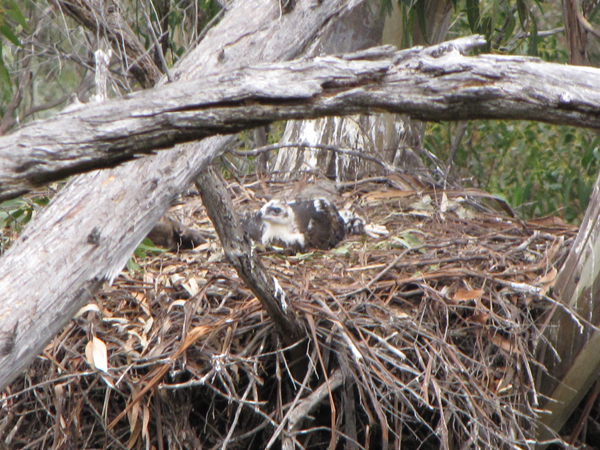
Wedge-tailed eagle chick, 2-3 weeks old (Photo: Leigh Walters)

The Tasmanian Midlands is recognised as one of 15 areas in Australia as a “biodiversity hotspot”.  These are areas of national significance, with high concentrations of threatened species and vegetation types.

On a recent visit to a private grazing property on the banks of the Macquarie River, north-east of Campbell Town, Matt Taylor, TLC Conservation Scientist and  ecologist Matt Appleby of Bush Heritage Australia were lucky enough to catch a soaring wedge-tailed eagle on video.

The Tasmanian wedge-tailed eagle is perhaps the Midlands’ most recognisable threatened animal species. This huge and majestic bird is often seen circling above woodlands and grasslands in search of prey.

This short video was taken when the Matt’s were completing an ecological assessment.  The eagle was riding an updraft that was formed as a strong north-westerly wind swept over a low hill.

If you would like to view the video click here.

To read more about our work please visit our website.

Interesting Facts:  The Tasmanian wedge-tailed eagle is brownish-black to almost black when mature. The feathers are wedged with a lighter brown. The legs are feathered and the bird has a long, wedge-shaped tail. It is a massive bird, standing over a metre tall, weighing up to 5 kg, and with a wing span of up to 2.2 m.

Tasmanian wedge-tailed eagles have been isolated for 10, 000 years from their mainland counterparts and have become a separate subspecies. With only about 130 pairs successfully breeding each year in Tasmania, the wedge-tailed eagle is listed as endangered.(1) (1) Parks and Wildlife, Tasmania

GetUp shakes up with a new leadership

A bit delayed to post this, but here’s from the inbox. GetUp National Director Simon Sheikh has stepped down while introducing incoming National Director, Sam McLean.

Simon Sheikh (right) with incoming National Director, Sam McLean (left).

Dear friends,

I wanted to let you know that I have decided the time is right to step down as National Director. Of course, GetUp will continue its work, and I can’t wait to see what comes next.

When I first took on this role in September 2008, many were still wondering whether this movement of ordinary people could continue to make a difference, or whether it would invariably prove a momentary trend; a flash in the political landscape.

Over the years you have proven that this movement of everyday Australians has the capacity to take on and win tough fights and strengthen democracy in the process.

GetUp is driven by its members. Over and over again we’ve demonstrated unequivocally that all of us working together can change things for the better. It has been an honour to stand alongside you over these last four years.

While we celebrate what we have won we should remember what we’re still campaigning for: a nation that better reflects the generosity of spirit, innate sense of fairness, strong community pride and ever-ready humour of its people. A nation that does not shrink back and buy into fear or division. A nation unafraid to aim higher and to understand its place in the world.

Expressing our belief in these ideals by collectively organising will be even more crucial as we approach the next election, a time when our movement can demonstrate its creativity and passion and make a huge impact along the way.

I’ll forever remember walking out of the High Court with two GetUp plaintiffs in a victory that gave over 150,000 Australians the opportunity to vote; standing alongside GetUp members in the Senate gallery the moment the clean energy bills passed; or the night I learned, in a budget lock-down inside the bowels of the Commonwealth Treasury, that, along with our partner organisations, we had won a massive increase in mental health funding. These moments are your victories: they would not have happened without your passion, actions, contributions and presence at every step. And they are just a taste of what this movement can achieve into the future.

Thank you.

It is my great honour to formally introduce to you GetUp’s new National Director, Sam McLean. Sam walked through GetUp’s doors as a volunteer over five years ago, and long-time members will remember the very first initiative he led: ‘Oz in 30 seconds,’ the ground-breaking competition that gave ordinary Australians the chance to create and air their own political ads during the 2007 federal election. Sam is a person of rare talent, energy and proven commitment to GetUp members and all that we fight for. You will have seen many emails from him, especially in his time as GetUp’s Deputy National Director over the last two years. His commitment to serving GetUp’s membership makes my decision to leave much easier.

I’ve suspected for a while now that it’s time in my own life for a change of pace. So while I’m fortunate to be back in good health, my next plan is to pack up the car and head out to see more of this remarkable country with my wife Anna, who has offered me so much support during my time at GetUp. After all, there are plenty of extraordinary places our movement has worked hard to protect. Now I’m personally keen to spend some time enjoying them!

GetUp is not, and never will be, the achievement of its small group of staff. It is the alchemy of many people becoming more than the sum of its parts: people united by common values, committed not just to reading the news, but to changing it.

I’m not going anywhere just yet; I’ll stick around for a while to ensure a smooth transition. But I wanted to make sure you heard this news from me first. And I wanted to take this chance to pay tribute to you – to thank you for all that you are, and all that you do 

Here’s to tomorrow, Simon

P.S. Over the last few years I have been supported by a huge number of volunteers, interns and staff. I wanted to particularly thank our current talented team who continue to drive so much of our work: Sam, Darren, Erin, Paul, Rosie, Rohan, Kieran, Kelsey, Justine, Simon DW, Jarra, Sara, Richard, James, Adri and Jess.

Mining boom over, Rio Tinto announces job cuts

Barely two weeks after Deliotte Access Economics predicted the end of the mining boom by 2014 or so, Rio Tinto announced its massive job cuts in its Sydney and Melbourne offices Tuesday.

Sky News reported the Sydney office with 30 employees will shut down, while about 240 administrative staff in Melbourne will go.  Of the estimated 200 workers at the technology and innovation research centre in the Melbourne suburb of Bundoora, not a significant number will be affected. Some roles will also be relocated to operating division hubs in Perth and Brisbane.

Rio Tinto Chief Executive Tom Albanese notified employees on cuts in jobs and services around the globe (Photo: Reuters)

Job cuts is the way to deal with falling commodity prices and soaring costs, a spokesperson said.

The warning came in June when Rio Tinto chief executive Tom Albanese and Australian boss David Peever emailed their staff about plans to cut support and service costs by 10 per cent around the globe. They said they are building resilience and controlling costs during a difficult time, which includes commodity price falls and Europe’s debt crisis.

“This includes a program of reductions in service and support costs across the organisation, which have been rising sharply in recent times….Miners are complaining about rising input costs, leading in to this month’s earnings season, including wages, equipment, energy and new taxes.”

Rio’s first half net profit is tipped to fall to about $US4.9 billion ($A4.69 billion) from $US7.78 billion ($A7.44 billion) last year.

Another mining giant, BHP Billiton, is also experiencing the pinch. Its earnings have been also forecast to drop, similar with the world’s biggest iron ore miner, Vale, which posted lower than expected second quarter earnings at two year lows in the recent weeks.

Deloitte Access Economics issued the sternest warning of troubled times ahead for the mining sector. It said the boom will end in two years or so.

Argyle Diamond Mine in Western Australia (AFP: Emmanuel Dunand)

Access’s Chris Richardson admitted the boom significantly boosted Australia’s economic growth, “but the peak of the project pipeline is already in sight.”

Investment in resources projects – the key driver of the boom – is looking “less certain the further out you look”, Richardson said.

Access, Australia’s leading private-sector economics advisory said, “Mining companies are making it clear the current spike in investment is due to decisions taken a while back, whereas we are getting few new mining mega-projects across the line.”

Blog Link: ASIAN CORRESPONDENT

Australia’s mining goddess acquires Fairfax media

Mining magnate Gina Rinehart grabbed the largest stake at Fairfax Media with additional 42 million shares costing $25 million which she bought in just one transaction today. This increased her total share at the company to almost 15 per cent from 13 per cent, The Australian reported.

Gina Rinehart grabs Fairfax. (Photo: Patrick Hamilton/Perth Now)

Rinehart bought the shares at a price of 60 cents per share. The trade was worth $25.2 million representing 1.8 per cent of Fairfax’s total issued shares, the AAP said at noon.

Perth Now, however, is following up latest developments including a dramatic approached for 235 million shares which was made after the local sharemarket closed, with the offer available till 8pm.

Fairfax is one of the two biggest and most influential media conglomerates in Australia, along with the News Limited owned by the old-rich Rupert Murdoch’s clan.

Perth Now also noted Canberra Media analyst Peter Cox who believes Rinehart is increasing her stake to boost her influence in national affairs. He said Rinehart has already acquired Ten News as a financial investment.

“So this has to be driven by her view on politics in Australia…What’s the point of spending that money on it if you’re not going to have influence?”

The latest stake must be a way to go forward fulfilling the prophesy of climate sceptic Lord Christopher Monckton who advised the rich to capture the media to advance free-market agenda.

Australia’s mining magnates: Clive Palmer, Gina Rinehart, Andrew Forrest

Monckton spoke last year to free-market think tanks in WA on “How to better capture the Australian media to help push a right-wing, free-market and climate sceptic agenda.” It was a boardroom meeting hosted by the Mannkal Economic Education Foundation, a group chaired by mining “Hall of Fame” member Ron Manners to promote free-market ideals and low government intervention.

ABC’s The Drum said Manners is a member of Gina Rinehart’s lobby group ANDEV, which has been joined by the Institute for Public Affairs to lobby for a separate low-tax low regulation economic zone for the north of Australia to make mining projects easier to develop.

The original version of the video has been deleted from You Tube, but GetUp reposted it with transcription capturing Monckton’s verbatim sinister claims:

Is there an Australian version of Fox News?… No….

Frankly whatever you do at a street level, which is what you are talking about here, is not going to have much of an impact compared with capturing an entire news media.

You look at the impact that Andrew Bolt has had since he was rocketed to fame and that is the way to do it, you have to capture the high ground of what are still the major media, and what will remain for quite some time.

And until we crack that one both in the UK and Australia, we’re going to suffer from an disadvantage, against the more libertarian right-wing minded people in the United States…who have got Fox News and have therefore got things like a Tea Party, have at last put some lead into the pencil of the republican Party.

And it seems to me that putting some time into encouraging those we know who are super rich to invest in perhaps even establishing a new satellite TV channel is not an expensive thing, and then get a few…Joe Novas and Andrew Bolts to go on and do the commentating everyday—and keep the news free and fair and balanced, as they do on Fox. That would be breakthrough and give to Australia as it has for America a proper dose of free market thinki

The Australian said Rinehart admitted her desire to control two board seats at the media company which publishes The Sydney Morning Herald, The Age in Melbourne, and the Australian Financial Times. The company also controls the auction website TradeMe, as well as the Southern Cross Broadcasting network of radio stations.

Amid mining boom, Rinehart was also the first mining magnate to get the approval from the Federal Government to import 1715 foreign workers under a new type of 457 visa for the three-year construction phase of Roy Hill iron ore mine in Western Australia.

Caricature to mock Rinehart’s foreign workers (By Nicholson)

The scheme angered local workers and labour unions. Labour observers said Rinehart will take advantage of skilled foreign workers that come with cheaper wages.

This year, the BRW magazine named Rinehart as theworld’s richest woman with $29 billion mining fortune making her $3 billion richer  than Christy Walton’s, the widow whose inherited wealth springs from US retail giant Wal-Mart.

The ABC said “Ms Rinehart has ridden Australia’s resources boom like no-one else; her wealth ballooning by an unparalleled $18.87 billion in the past year….That equates to $1,077,054 every 30 minutes of every day.

Blog LInk: Asian Correspondent

Gas firm to finance West Australia’s new “Dubai”

Western Australia (WA) is set to defy all oppositions to chase its dream to turn Broome into a key tourist destination– including a court’s injunction order to stop gas giant, Woodside Petroleum, from drilling at a site in James Price Point. With Woodside offering big bucks to finance WA’s tourism promos, the State Government could not back down.

The North West Australian Tourism was more pleased to announce its intention to receive the $180,000 offered by Woodside to strategically position Broome as a major attraction that will enable WA to compete with other destinations Australia-wide.

The announcement sealed the fate of Broome, ignoring pleas from environmentalists, local residents, and indigenous land owners who have staged protests and demonstrations day in and day out against the proposed gas hub. Oppositions said gas is going to destroy the ecological, historical, cultural value of Broome.

The Australian Greens warned no one wants the project except Woodside and the Premiere Colin Barnett. The party also claimed Woodside’s partners were initially reluctant to the gas venture but have been “forced” to join in by the WA Premier and Federal Minister Martin Ferguson.

And who wants this hub? No one other than Woodside and the Government. Not the general public, not the local community, not the Aboriginal community, not the environment movement, not even Woodside’s business partners.

Woodside Petroleum has joint venture partners Shell, Chevron, BHP and BP in the project who are reluctant to go to the Kimberley but have been forced into it by the WA Premier and Federal Minister Martin Ferguson.

Broome residents said Woodside have purchased the souls of the locals with its money masquerading as charitable work.

Australia’s  North West Tourism welcomes the fund offer which will significantly help to promote Broome tourism amid a “tough domestic market, the WA newspaper reported adding that Chairman Chris Ellison believes the funding will help boost the image of Pilbara and Kimberley.

As the peak tourism marketing body for the Pilbara and the Kimberley, our members look to us to deliver a strong and engaging message to consumers about the positive tourism aspects of our region.

This additional funding will enable us to better tell the unique story of Broome, as the major tourism gateway to the region, and why it continues to be one of the best holiday destinations in Australia.

Police has become ubiquitous in James Price Point to suppress oppositions. The WA Government, however, said the police presence is aimed at maintaining peace.

Lyndon Schneiders, nationl director of The Wilderness Society wrote to The Australian saying. “the mini army has been assembled on the doorstep of the Kimberley wilderness for one purpose — to suppress the widespread opposition of the Broome community to the construction of the proposed $40 billion James Price Point industrial precinct.”

All this to move away and silence a dogged and growing band of locals who have stood in the way of the plans of a consortium of the world’s biggest companies, including Shell, Chevron, Woodside, BP and BHP Billiton, to build this massive gas plant in a beautiful and sensitive part of the remote Dampier Peninsula.

WA police commissioner Karl O’Callaghan admitted the police squad is costing Broome’s taxpayers $100,000 per day.

While the saga of Broome goes on, Woodside also awaits today the decision by the Perth’s Court of Appeal whether its drilling works at the contentious Browse gas project is legal or not.

A traditional owner and senior member of the indigenous Goolarabooloo people, Richard Hunter, has alleged the approval granted to Woodside in February was invalid because the Kimberley Joint Development Assessment Panel did not wait to receive an official report from the Shire of Broome.

Hunter applied for an injunction in the said court to stop major earthworks and geotechnical activities of the project. The company is also ordered to not do work in the beach or dune area.

Read related article here.

Blog Link: Asian Correspondent