Greens join forces to save the Tarkine

The Wilderness Society, Tarkine National Coalition, and GetUp! joined forces in the campaign to protest the “out-of-control” mining ventures in the Tarkine in Tasmania and push for its enlistment in the World Heritage Site.

Convoluted rocks at the west coast off Tarkine. (Photo: Flickr)

Massive banners in front of a proposed Venture Minerals’ open cut mine in the Meredith Ranges have been unveiled as part of the Tarkine wilderness. Tarkine is claimed to have been recently assessed by the Commonwealth and Tasmanian Governments to have a national and World Heritage values prompting strong community oppositions to any developmental aggression.

Here’s from the campaigners:

Liz Johnstone, Tarkine campaigner for The Wilderness Society, said many of these values, however, are under threat from new open cut mines. Some are proposed in existing conservation reserves that have been watered down to allow mining and exploration.

Venture and a range of other companies have plans to build strip and open cut mines in the region, ahead of the findings of an Australian Heritage Commission assessment of the environmental significance of the area.

Miners, Australian Workers Union join forces to support mining in the Tarkine. (Photo: ABC)

Paul Oosting, campaign director for GetUp, said the Tarkine has evolved over 40 million years to be what is now one of the few last remaining wild places on the face of the planet, yet Venture Minerals wants to go into what is currently a conservation area and strip mine it for just 2-8 years.

“Today we have seen the Tasmanian community stand up and take action to not let this happen and we know that they have the support of people from around the country who want to see this area properly protected,” Oosting said.

Vica Bayley, campaign manager for Wilderness Society Tasmania, said that the event signals an escalation of the community campaign and a counter to the provocative actions of the Australian Workers Union and the mining industry who are pre-empting the current national heritage assessment and pushing ahead with risky mining proposals.

“The AWU, the mining lobby and companies need to back off and allow due process and the heritage assessment to conclude before locking in destructive proposals that threaten the values of the area and impact on the heritage listing that previous assessments prove this region deserves,” Bayley said.

GetUp’s “Save the Tarkine” campaign

The action before Monday’s (24 Sept) Extraordinary General Meeting of Venture Minerals’ shareholders in Perth, where a decision will be made on capital raising needed to kick start its mines in the Tarkine. “The company, its shareholders and financial backers must realise that mining World Heritage value wilderness is a risk not only to the environment, but also to their investment,” Bayley said.

More info about this campaign: Tarkine National CoalitionWilderness Society Tasmania, GetUp!

Tasmanian Premiere Lara Gidding maintains that the Tarkine is insignificant, with mining representing only one per cent of the region.

Blog Link: Asian Correspondent

Tarkine Wilderness begs Govt protection

What’s the fuss about Tarkine?

“Here, some of the tallest and oldest trees in the world are being logged for woodchips — irreplaceable virgin forests converted into toilet paper.” – The Green Left

Discover the hidden treasures of the Tarkine (Photo: Carol Haberie/Tarkine Wilderness of Tasmania)

This is one of the uncomfortable truths about the current state of the Tarkine, one of the last remaining pristine wilderness of Tasmania and claimed to be disturbed by logging and open cut mining operators.

Tarkine could be an unfamiliar destination to most intrepid travelers, but to those who know this place by heart, Tarkine can match the beauty and historical significance of iconic spots such as the Ayers Rock (Uluru), Sydney Opera House, or Bondi Beach.

The Tarkine is the largest wilderness in the north-west region of Tasmania sprawling over 477,000 hectares. It is dominated by pristine rainforests with dramatic view of wild rivers, deep gorges, and waterfalls. About 70 percent of the total area is rainforest, 90 percent of which is regarded as old-growth forest.

Arthur River rainforest in the Tarkine (Photo: Tarkine.org)

The Tarkine is considered by conservationists as one of world’s oldest rainforests. It hidden treasures contain relics from the ancient super-continent, Gondwanaland. It is home to more than 60 rare species. Unique animals include the Giant Freshwater Lobster – the world’s largest freshwater crustacean; the Tasmanian Wedge Tailed Eagle – Australia’s largest Eagle; and the famous Tasmanian Devil.

However, environmental groups lament its lack of government protection. Increased commercial activities in area are claimed have posed a serious threat to various species, some of which are now considered endangered.

Green groups believe Tarkine should be given equal importance like other great Australian landmarks. As such, Tarkine has been pushed for listing in the World Heritage Site. But its listing faces no paved road – hampered by the Government’s dilemma between conservation and economic pursuits.

The fact is both the Federal and State governments do not think Tarkine should be listed.

The Tasmanian Devil is one of the species under threat.

The Federal Government said it has enough protection while the Tasmanian State Government said logging and mining will create and sustain jobs and livelihood.

Early on, The Mercury reported the State Government supports mining ahead of the environment in a submission to the Federal Government on whether the Tarkine Wilderness Area should be protected by national heritage laws.

The report said Energy and Resources Minister Bryan Green admitted the State Government “desperately wanted to see lucrative projects such as the multi-million-dollar Mt Lindsay tin mine reach fruition.”

Dollars generated by mining can surpassed dairy, beef, and wine combined. The mining ventures of St Lindsay mine, for one, aims to target the world’s second-largest tin deposit that overlaps part of the Tarkine in the state’s North-West. It could generate up to $250 million annually, the report added.

Tasmania Priemiere Lara Giddings also admitted mining industry is a crucial source of income for the Government. The ABC reported she is adamant the Tarkine’s proposed listing should not compromise future mining operations.

She says low impact operations similar to MMG’s new Southern Hercules open cut mine at Rosebery can occur in the Tarkine without compromising the region’s environmental values.

“Mining is an essential part of the Tasmanian economy, it has a royalty benefit to the State Government which helps to contribute to our state budget as well, so we’re keen to see mining continue.”


Rare species inhabit the Tarkine (Photo: Discovertarkine.com)

The Age has traced back the history of the campaign to protect the Tarkine. It says it started from Tasmanian forests disputes way back the 1980s. Former Green Senator Bob Brown suggested the name “Tarkine” to honour the memory of the local indigenous Tarkiner people. The campaign was initially dubbed “For the Forests”. Since then frequent skirmishes over its protection have become common.

Ever since there has been skirmishing over its protection – no more so than in the case of the ”Road to Nowhere”. This 70-kilometre, north-south link road cutting across the wilderness’ western side took seven years to build – and was stopped and restarted by successive governments.

When the road opened in 1995, then Premier Ray Groom claimed it as proof the tide was turning against environmentalists. It remains little used.

Logging into the northern fringes of the Tarkine has a long history and has met few protests. Its most contentious timber is the rainforest myrtle – a deep-red cabinetmaker’s delight. Under the Howard government, 70,000 hectares of myrtle rainforest was reserved in 2005.

Guided tours are provided in the Tarkine (Photo:tarkinelodge.com)

The Tarkine Wilderness has been waiting for enlistment as a national park for the past three decades, but the Federal Government is delaying it for further consideration.   UK-based The Independent noted the Government is unconvinced of its listing while the the WWF, among with other Green groups have been watching for the development of  the Tarkine’s listing. View timeline here.

While the Tarkine awaits, the Tarkine National Coalition fears ten new mines will put up over the next five years.

Blog Link: Asian Correspondent
Against native forests’ logging and retailing

Here’s from the email inbox: The Last Stand announced its new anti-Ta Ann Group website to discourage Japanese clients from buying Tasmania’s plywood disputedly harvested from native old-growth forests.

The banner design of the new cyber campaign

Likewise, here from the website of Market for Change which posted the list of local retailers of Tasmania’s native forests.

Tasmanian native forests' local retailers

The activists’ group has drawn a map on the extent of forest destruction in Australia– in which some of Australia’s most unique and species-rich forest habitats are still being logged including:

  • Tasmania’s native and old growth forests including the Tarkine, Blue Tier, Styx, Weld, and Upper Florentine Valley areas
  • Victoria’s Central Highlands – identified as some of the most carbon-dense forests on earth and areas in East Gippsland
  • New South Wales’ highly biodiverse sub-tropical and temperate native forests in the state’s north-east and south-east coastal regions
  • Western Australia’s native forests in the southwest of the state have been named a global biodiversity ‘hotspot’ yet logging in the state’s endemic karri, jarrah, marri, tingle, and tuart  forests continue despite new threats from drought and disease.

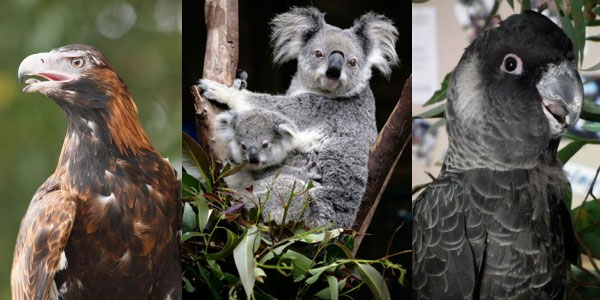
It speculates that there are 1,287 forest-dwelling species accross Australia that are listed as vulnerable, threatened or endangered under the Australian Environment Protection and Biodiversity Conservation Act (EPBCA) 1999. They include:

  • The Tasmanian Wedge-Tailed eagle
  • Carnaby’s Black cockatoo of WA.
  • Victoria’s Leadbeater’s possum
  • The koala population of southern NSW.

These species are losing their homes

This campaign has hit the media big time, with the launch featured in the Australian – a rare event indeed!  It is also a hot topic in Tasmania with regular mentions in the local press.

Our online action is doing great, heading up to 1500 emails now, and crew in Hobart have maintained a strong visual presence, letterboxing key areas and, most recently with the Ta Ann

We are continuing to work with Markets for Change and the Huon Valley Environment Centre as well as heaps of other good folks, and have also appreciated the support of the most excellent peoples at DoGooder.

So spread the message to your friends to jump on board!

For the forests,

THE LAST STAND CREW