IPCC report will make no difference in culture of denial

Re-posting this article:

 By  Clive Hamilton

This week’s Intergovernmental Panel on Climate Change (IPCC) report will be compendious, cautious, thorough and as authoritative as a scientific report can be. But it will not make much difference.

In the world we used to live in, the one in which the ideal of scientific knowledge held true, the report would give a further boost to an already valiant world effort to shift rapidly away from fossil fuels. It would give hope that we could head off the catastrophes of a hot planet.

But we no longer live in that world (otherwise known as the Enlightenment), the one in which we thought of ourselves as rational creatures who gather evidence, evaluate it, then act to protect our interests.

While the IPCC must continue to tell those who are listening what the science is saying, it ought to be obvious to any careful observer that the debate over climate change is not about the science. Continue reading The Conversation

Abbott dumps climate watchdog, skeptics rejoice

Climate deniers are rejoicing over the abolition of Australia’s Climate Commission, along with the sacking of its commissioner, Professor Tim Flannery.

New Prime Minister Tony Abbott wasted no time in disbanding the nation’s climate watchdog on Thursday in order to deliver his election promise right after he was sworn into office. Plans to scrap other climate-related bodies are now underway.

Professor Tim Flannery, 2010 Australian of the Year, was the head of the Climate Commission until Sept 19, 2013. (Photo: Gemma Jones/ News Ltd)

Jo Nova, in her website, screamed, “Taxpayers rejoice! The science-propaganda agency is gone for good. One down — scores to go.”

Nova praised Abbott’s Coalition government in its decision “to cut waste and to stop funding an inept unscientific agency which was unbalanced to the point of being government advertising in disguise.” She said the commission wasted billions of dollars on useless and scientific projects, including desal plants, solar panels and wind farms.

Andrew Bolt also welcomed Abbott’s decision although he said the new Environment Minister Greg Hunt made one mistake when he sacked Flannery: thanking him for his work. ”Thank Flannery? Hunt should instead have asked Flannery how much of his $180,000 a year salary he’d refund after getting so many predictions wrong,” he quipped.

The Coalition Government will also dump the Climate Change Authority– set up in 2012 to provide independent advice to the government on the carbon price and emissions reductions targets, along with the legislation to scrap the Clean Energy Finance Corporation (CEFC). Also set up in 2012, CEFC has been provided with $10 billion in funding over five years to support private investment in renewable energy.

All climate-related bodies will be streamlined under the Department of Environment.


Anti-wind turbines cartoon by Steve Hunter posted at Andy’s Rant’s website.

Abbott gained notoriety when he said saying climate change was “crap” and therefore not a priority in his government. The Greens have tagged him as a “climate criminal”.

Observers said climate change was a highly politicised issue between the right and left wing.

The Abbott camp alleged that climate change “is part of a vast left wing conspiracy to deindustrialise the world.”

In an interview with the The Telegraph, Abbott admitted “the carbon tax has been a handbrake on the NSW economy” and scrapping the carbon tax will assure Premier O’Farrell that his top legislative priority will give an “adrenalin shot for local business…”

Alex White of The Guardian posted two reasons why Abbott wanted to scrap the pollution tax. One speculated Abbott was a skeptic, but the other was more politically compelling because climate change denial stemmed from “powerful vested interests in Australia, including the fossil fuel lobby, mining industry and carbon intensive corporations” which “are heavy donors to Mr Abbott’s Liberal Party.”

Major donors to the Liberal Party prior to the 2013 election, according to the Australian Electoral Commission include mining company Santos ($227,880), Clive Palmer’s Minerology ($459,900), nickel miners Minara Resources ($358,000) and Mincor Resources ($120,000), Newcastle Coal Infrastructure Group ($50,000), and oil giant Chevron ($28,500).

The Labor leadership contender Anthony Albanese and Greens Senator Christine Milne are both distraught with Abbott’s decision to discard the climate commission.

Albanese said in a speech on Thursday the move to scrap the commission was “shameful”, while Milne said “issuing instructions to close the authority was irresponsible in the face of dangerous climate change.” She added that in the context of global warming, Abbott’s action was a crime against humanity.

Blog LInk: The Green Journal @ Asian Correspondent

New Abbott gov’t heads for environmental disaster, expert warns

A day after Tony Abbott was elected as the new Prime Minister of Australia, conservation groups are already worrying about the future of environmental protection and sustainability in the country.

Under the new “management”, a term used by Abbott in his acceptance speech at the Four Seasons Hotel in Sydney, his government will put environmental issues on the back burner to get the business back on track.

Tony Abbott (top) won the 2013 federal election to become Australia's 28th prime minister beating Kevin Rudd who conceded defeat on Sept. 7.

Abbott won Saturday’s Federal Election to become Australia’s 28th prime minister, beating Kevin Rudd in an overwhelming victory.

In a reaction to his election, however, Emeritus Professor Ian Lowe from the School of Science, Griffith University said Australia’s newly elected government will be disastrous for the environment. He finds the Coalition Government’s policies on environment to be depressing, The Conversation reports.

Under the Liberal Party’s plan, Abbott will seek to abolish the carbon tax immediately, which he considers toxic and destructive for Australian businesses. The new PM also vowed to suspend the operation of the Clean Energy Finance Corporation.

Citing New South Wales as an example of bad business affected by carbon tax, Premiere Barry O’Farrell has made it clear that the state’s black coal-fired power stations will suffer a loss in value of at least $5 billion because of the carbon tax.

Abbott will also abolish the mining tax which he claims undermines investor confidence in Australia as an investment destination and as a secure “supplier of resources.” By scrapping the tax, the Coalition aims to “restore confidence, stability and security for the industry, allowing it to thrive, create jobs and contribute to the prosperity of all Australians.”

Green groups have been alarmed at the Coalition’s plan to implement a One-Stop-Shop Environmental Approvals Process. The process will cut green tape and will fast-track approvals of new mining and other projects. Once it gives  green light to the petition lodged by the Business Council of Australia, the Coalition will offer State and Territory governments the opportunity to act as a one-stop-shop for environmental approvals. The States and Territories would then administer a single approvals process including approvals under Commonwealth legislation such as the Commonwealth Environmental Protection and Biodiversity Conservation Act. The Environment Defenders Office has already released a report that finds the One-Stop-Shop a process to streamline the process of environmental destruction. Read related article here.

Lowe said Abbott’s  proposal will turn the clock back 30 years on environmental protection.

“Since the Hawke government blocked the proposed Franklin Dam, successive governments – ALP and Coalition – have curbed the worst excesses of growth-oriented states, which are prepared to approve irresponsible developments. Even our National Parks are no longer safe,” he said.

Other plans in the Coalition pipeline include a go for mineral exploration activities; agricultural land exploration for seam coal gas; approval of uranium exports to India; examination of the potential of thorium as an energy source for export; and a review of the former government’s White Paper on energy and resources, among other things.

Relevant links to the new government’s policies are here, including resources and energy plans.

Blog Link: Asian Correspondent’s Green Journal

Queensland granny walks 1200 km to Save the Reef

A 72 year-old grandmother ended her 1,200 km-walk from Cairns to Gladstone in Queensland on Thursday last week to remind Australian voters to think about the Great Barrier Reef.

June Norman completes her 1,200 km walk to Save the Reef.

June Norman is the hero of the day for having just completed her 80-day journey. She took the Reef Walk 2013 from her hometown Cairns to raise awareness of the impacts of coal seam gas (CSG) exploration projects and the LNG export industries to the Great Barrier Reef.

She arrived in Gladstone with a parade of colourful banners. She hopes that people will think about the election and choose candidates who care about the reef. She said voters should not pick the same old political party, but find out if their policies include the reef. The federal election has been set on Sept. 7.

This is what she has to say about her 80-day journey:

“I started this journey more than a year ago, with planning and contacting other concerned people, tourist operators and fishermen all along the coast. The last few months have been some of the best days of my life. Every day I met wonderful people with passion to protect the Reef.”

“One thing life has taught me is there is nothing more important than family, and this journey has been one small thing I can do for my grandchildren. It’s what every mother wants, a good future for their children, and I want my grand kids to enjoy the world and the Great Barrier Reef like I have.”

“I just don’t understand, why are we allowing international companies to come here and destroy this beautiful world heritage reef. The dredging in Gladstone should be a warning to us all, we will see dead dugong and turtles all along the Queensland coast if we don’t stop the new coal and gas ports.”

“All I ask is that Mr Campbell Newman and Mr Kevin Rudd stop for just one day and take a trip to the reef. Stop and feel its beauty. Perhaps then they might consider stopping this madness”

Climate change and rapid industrialisation are putting the Great Barrier Reef under enormous pressure. With the growing commitment to coal export markets and CSG industry, new major coal ports are underway. From Gladstone and the Fitzroy Delta to Abbot Point near Mackay require millions of tonnes of sea bed dredging that is impacting turtles, dugong, and dolphins.

The Friends of the Earth, in a joint statement with Norman said the cumulative impacts of LNG and coal projects to the reef have not been considered or quantified. The pace of industrialisation is so rapid that marine turtles could disappear before their life cycle is understood. Investigations are rapidly under way to protect Gladstone’s Fitzroy Delta Subfin Dolphin before port development begins.

Reef Walk is a message that conveys the hopes of many Australians wanting big steps to be taken to protect the Great Barrier Reef. The reef is home to countless marine species and the work place of thousands of Queenslanders supporting the tourism sector.

Meanwhile, Greens leader Christine Milne will be announcing the party’s plan to save the Great Barrier Reef in Airlie Beach on Friday. She will be flying over Abbot Point to see the area to be impacted by the big mining companies if the Queensland Government continues to allow them to operate. (On Friday, the Greens announced it has launched a $176 million rescue package to protect the Great Barrier Reef from mining.)

The Greens said neither of the old parties have ever refused a coal or gas mining proposal yet but the Greens will continue to do everything in its power to stop the approval of the Abbot Point coal port expansion and save the Great Barrier Reef from becoming a dredging dump ground and shipping super highway for the big mining companies.

June Norman with her Reef Walk 2013 crew.

“Only the Greens can be trusted to stand up to the big mining companies to protect the Great Barrier Reef, with our  policy of no new Reef dredging or dumping,” Senator Larissa Waters said in a party statement.

Blog Link: Asian Correspondent

Australia maps out smart energy plans

Re-blogging:

Climate solutions think-tank Beyond Zero Emissions (BZE) and the University of Melbourne are launching a joint project that hopes to help developers build smarter buildings: eco-friendly and energy-efficient.

The Zero Carbon Australia Buildings Plan, to be unveiled Thursday, will showcase a blueprint aimed at helping existing buildings cut their energy usage by half. Residential and commercial buildings can achieve maximum energy efficiency in 10 years.

BZE Research Director and Lead Author Trent Hawkins notes Australian buildings are not up to the challenges of the time. They are generally “too hot in summer, too cold in winter, and use a phenomenal amount of energy to run basic services,” he explained. The plan also scraps gas-operated appliances to be replaced by more efficient and healthy technology. “This plan shows how Australia can transform our existing buildings to reduce energy bills, increase comfort and health, and generate renewable energy,” he said.

The plan projects residential building sector to cut 53 per cent of energy use, with some typical home categories seeing over 70 per cent reduction, and commercial buildings can reduce energy use by 44 per cent.

Going gas-free is a key element of moving towards zero emissions. The plan, if implemented, has multiple benefits: households get a new level of control over their energy bills, it could remove the need for the polluting and unpopular coal-seam gas industry, and it would stimulate employment in trades and services for the buildings sector by tens of thousands of jobs, BZE said.

Australian households spend $15 billion per year on electricity and gas bills. The modelling shows that this plan could save up to $40 billion over the next 30 years, compared to business as usual,” Mr Hawkins explained.

BZE introduced the idea of a 100 per cent renewable electricity grid to Australia’s political and public discussion with the 2010 Stationary Energy Plan.

Mr Hawkins concludes his group wants to start the conversation on how Australia can fix its buildings. “By taking action now, we can start to curb the environmental impact of our energy-hungry buildings – and improve life for us as occupants,” he said.

BZE is one of the grassroots’ movements that support Australia’s drive towards a cleaner and more sustainable energy source.

Solar Power

By 2020, Australia aims to generate 20 per cent of its energy needs from renewables. The Climate Commission earlier released a modelling of Australia’s future energy usage that consistently indicates increased reliance on solar energy. By 2050, solar photovoltaics are projected to provide 29 per cent of Australia’s power needs.

Last year, the Climate Commission released a report– The Critical Decade: Generating a renewable Australia– which projects the unlimited potential of renewables, particularly solar.

The report underscores a major shift in global energy policy moving towards renewables and Australia has an advantage given the enormous potential for solar generation as the world’s sunniest continent.

The report also highlights major developments in Australia such as the cost of solar photovoltaic systems which have significantly dropped over the years enabling more consumers to shift to such technology.

In 2012, over one million rooftop solar photovoltaic systems were installed, up from about 8,000 in 2007. About 2.6 million people, 11 per cent of our population, now use the sun for their electricity needs, the report said.

The Commission also admitted that while Australia generated $60 billion from the export of coal and gas, 80 per cent of global fossil fuel resources need to stay in the ground to limit global temperature increase to a relatively safe 2C.

Largest solar panels in the Southern Hemisphere

Last week, Australia reached another milestone with the announcement of large-scale solar power stations to be built in New South Wales costing a combined total of $450 million.

The Australia Renewable Energy Agency approved the fund of $166.7 million while the NSW Government committed $64.9 million to support the project.

The power stations will be built in two separate locations: Broken Hill (NSW) and Nyngan (NSW) which will generate a capacity of up to 155 megawatts (MW) (AC) of electricity. Construction in Nyngan is due on January 2014 and Broken Hill, July 2014 to be completed in 2015.

AGL Energy Pty Ltd was named to build the project and has contracted First Solar to do the engineering, procurement and construction (EPC) of the project. First Solar will build the power stations using its thin film PV technology and will maintain the facilities for an initial five year period following construction.

The Federal Government says these will be the largest solar power stations in the Southern Hemisphere.

Mark Butler MP, Minister for Climate Change, said the project will cover a combined area four times the size of the Sydney CBD.

Blog Link: Asian Correspondent

GetUp shakes up with a new leadership

A bit delayed to post this, but here’s from the inbox. GetUp National Director Simon Sheikh has stepped down while introducing incoming National Director, Sam McLean.

Simon Sheikh (right) with incoming National Director, Sam McLean (left).

Dear friends,

I wanted to let you know that I have decided the time is right to step down as National Director. Of course, GetUp will continue its work, and I can’t wait to see what comes next.

When I first took on this role in September 2008, many were still wondering whether this movement of ordinary people could continue to make a difference, or whether it would invariably prove a momentary trend; a flash in the political landscape.

Over the years you have proven that this movement of everyday Australians has the capacity to take on and win tough fights and strengthen democracy in the process.

GetUp is driven by its members. Over and over again we’ve demonstrated unequivocally that all of us working together can change things for the better. It has been an honour to stand alongside you over these last four years.

While we celebrate what we have won we should remember what we’re still campaigning for: a nation that better reflects the generosity of spirit, innate sense of fairness, strong community pride and ever-ready humour of its people. A nation that does not shrink back and buy into fear or division. A nation unafraid to aim higher and to understand its place in the world.

Expressing our belief in these ideals by collectively organising will be even more crucial as we approach the next election, a time when our movement can demonstrate its creativity and passion and make a huge impact along the way.

I’ll forever remember walking out of the High Court with two GetUp plaintiffs in a victory that gave over 150,000 Australians the opportunity to vote; standing alongside GetUp members in the Senate gallery the moment the clean energy bills passed; or the night I learned, in a budget lock-down inside the bowels of the Commonwealth Treasury, that, along with our partner organisations, we had won a massive increase in mental health funding. These moments are your victories: they would not have happened without your passion, actions, contributions and presence at every step. And they are just a taste of what this movement can achieve into the future.

Thank you.

It is my great honour to formally introduce to you GetUp’s new National Director, Sam McLean. Sam walked through GetUp’s doors as a volunteer over five years ago, and long-time members will remember the very first initiative he led: ‘Oz in 30 seconds,’ the ground-breaking competition that gave ordinary Australians the chance to create and air their own political ads during the 2007 federal election. Sam is a person of rare talent, energy and proven commitment to GetUp members and all that we fight for. You will have seen many emails from him, especially in his time as GetUp’s Deputy National Director over the last two years. His commitment to serving GetUp’s membership makes my decision to leave much easier.

I’ve suspected for a while now that it’s time in my own life for a change of pace. So while I’m fortunate to be back in good health, my next plan is to pack up the car and head out to see more of this remarkable country with my wife Anna, who has offered me so much support during my time at GetUp. After all, there are plenty of extraordinary places our movement has worked hard to protect. Now I’m personally keen to spend some time enjoying them!

GetUp is not, and never will be, the achievement of its small group of staff. It is the alchemy of many people becoming more than the sum of its parts: people united by common values, committed not just to reading the news, but to changing it.

I’m not going anywhere just yet; I’ll stick around for a while to ensure a smooth transition. But I wanted to make sure you heard this news from me first. And I wanted to take this chance to pay tribute to you – to thank you for all that you are, and all that you do 

Here’s to tomorrow, Simon

P.S. Over the last few years I have been supported by a huge number of volunteers, interns and staff. I wanted to particularly thank our current talented team who continue to drive so much of our work: Sam, Darren, Erin, Paul, Rosie, Rohan, Kieran, Kelsey, Justine, Simon DW, Jarra, Sara, Richard, James, Adri and Jess.

Carbon tax gaining public support, poll says

Right-winged politicians continue to employ scaremongering tactics to thwart public support for the carbon tax which took effect on July 1. The public has also feared the new tax would hurt households.

However, the Climate Institute Chief John Connor said the misunderstanding is caused mainly by ineffective communication strategy implemented by the Government. Although advertising and promotional campaigns were put up, “the message hasn’t got through,” the Herald Sun reported.

According to new report by the Institute, the carbon tax gained more public support after the compensation package was explained more clearly.

In a poll conducted this week by Ipsos Social Research, the Institute released a report that shows an improved support for the carbon tax package— almost doubled after the compensation package is explained.

Earlier surveys showed that out of 1131 people, a significant 52 per cent opposed the carbon tax with only 28 per cent supporting it. But when it was explained the money raised goes to low and middle income households, businesses, and towards renewable energy, support jumps to 47 per cent while those opposing it tumbles to 29 per cent.

Other findings include:

  • 67 percent wants the Government to take a lead role in fighting climate change while 11 percent wants the Government out;
  • 61 percent were fearful the new tax would hurt the economy, but 43 percent believes it would dirve investment in renewable energy;
  • 36 per cent believe their households will be much worse off and 29 per cent say they will be a little worse off. One in five say they will be about the same and 10 per cent think they will be better off.
  • Opposition Leader Tony Abbott vowed a “blood pledge” to scrap the law if elected in 2013, but only 44 percent believe Abbott and the Coalition would repeal it.
  • The Government says about four million households will be better off, two million will come out even and three million will be worse off.

    Anti-carbon tax protesters march to show their opposition to the tax in Sydney, July 1 (Photo: AAP)

Meanwhile, Gujji Muthuswamy, adjunct lecturer and faculty of Business and Economics at Monash University said the carbon tax continues to create confusion because it has not been explained in “plain language.”  The Conversation carries Muthuswamy’s mock letter addressed to Prime Minister Julia Gillard explaining to the Australian public what the tax is all about.

Blog Link: Asian Correspondent 

GetUp! rallies behind Swan on mining tax

“Politicians have a choice… between standing up for workers and kneeling down at the feet of the Gina Rineharts and the Clive Palmers …”  – Wayne Swan, The Monthly, March 2012

Here’s from the email inbox:

The Government is talking tough about the need to ensure all Australians benefit from the resources we own. But here’s the stark truth: Over the next three years, as the Minerals Resources Rent Tax brings in $10.6 billion from the mining industry, around $8.5 billion will be handed back to them in tax concessions and loopholes!

Wayne Swan is making critical decisions over the next few weeks in an attempt to reach a budget surplus in 2012/13. As we’ve seen at budget time in years past, ideas are floated out in the weeks leading up to the budget to see how the public responds. Just this morning, news outlets began running the story that perhaps mining subsidies would be cut in the upcoming budget. As Wayne Swan takes the public’s temperature on this issue, let’s turn up the heat on him.

Can you make sure Swan stands up for workers by ending mining handouts? Chip in to put this ad on the air so that he hears from everyday Australians instead of mining magnates:

http://www.getup.org.au/end-billionaire-welfare

Mining magnates such as Clive Palmer and Gina Reinhart continue to rake in record profits at the same time as receiving billions of dollars in handouts (our tax dollars) from the Government.

Each year, mining subsidies on offer include (but are not limited to): – $1.89 billion under the Diesel Fuel Tax Credit Scheme [1] – $330 million under the exploration and prospecting deduction [2] – $250 million via an accelerated deprecation scheme that lets them write down their assets early [3] – $390 million in various research & development deductions [4]

This billionaire welfare is occurring at the same time as nurses, teachers, aged-care workers and other public sector workers face further budget cuts.

That’s why we’ve made an ad that highlights the stories of the people who really deserve the Government’s aid – people working for public interest, not vested interest.

Can you help get their message on TV screens before it’s too late?

http://www.getup.org.au/end-billionaire-welfare

It’s safe to say that at some point in our lives – if it hasn’t happened already – we’ll all depend on people like Clare, Michelle, Janice and Inge. It’s not right that they continue to work hard and pay taxes week in and week out, facing budget cuts and staffing shortages – only to have that money handed over to Clive and Gina so they can become even richer.

We can put a stop to it. Ask Wayne Swan to put our money where his mouth is and end handouts to big mining: http://www.getup.org.au/end-billionaire-welfare

Thanks for standing up for what’s right, for the GetUp team.

PS – With just weeks to go before the budget is handed down, the word out of Canberra is that key meetings to discuss policy options like ending mining subsidies are occurring over the next few weeks. Can you help us get this ad on the air as these important decisions are being made? http://www.getup.org.au/end-billionaire-welfare

Sources: [1] ‘Taxation Statistics 2008-09’, Australian Taxation Office. 2011. p 14 [2] ‘Tax Expenditures Statement 2011’,  The Australian Government the Treasury. January, 2012. p. 108 [3] ‘Drill Now, Pay Later’, Australian Conservation Foundation. September, 2011. p. 8 [4] ‘The Berd in the Hand Report’, Australian Business Foundation. April 2011. pp 18 – 25

Carbon tax unconstitutional, goes to high court

Mining billionaire Clive Palmer of Queensland Nickel

The carbon tax circus is not yet over.

Mining magnate Clive Palmer announced he will challenge Prime Minister Julia Gillard’s carbon tax to High Court saying it is unconstitutional.

Palmer said his legal advisers who are “all senior counsels with experience in the High Court” advised him to take legal action against the federal government on the ground of discriminating his company Queensland Nickel.  The Age  said his legal advice would be finalised next week and his company would probably lodge documents with the High Court by April.

Palmer said his lawyers advised him there were several grounds under which the carbon tax is unconstitutional. For one, he said his company was getting less compensation under the carbon tax than rivals BHP Billiton and Glencore.

A spokesman for Climate Change Minister Greg Combet, however, denied the claim saying the government was still awaiting audited data from nickel producers that would then be included in the compensation regulations.

The Age also noted Roland Burt, a principal at Macpherson and Kelley Lawyers, who singled out three potential avenues for a challenge. These include “Commonwealth external powers, the federal government’s power to impose taxes on the states, and the issue of whether tax law could be bundled up with other legislation.”

However, Burt doubts the success of the challenge:

”Clive Palmer will have some of the best legal minds in the country at his disposal and they will certainly put a powerful case….’But my guess is the government has thought about it all carefully enough to design it in a way that will probably – but by no means certainly – survive the challenge.

PM Gillard and her camp insisted that the carbon tax was strictly reviewed during its legislative development and has ”taken careful constitutional advice and legal advice at every stage.”

Greg Craven, a law professor and vice-chancellor of the Australian Catholic University, believes the carbon tax was ”inherently complicated” and ”was always going to end up in the High Court”.

It raised questions about the scope of taxation power, the rights of the states, the Commonwealth’s power to make laws binding the states, and the compulsory acquisition of property.

”If you were looking for a law that was born to be challenged, this is it, because there are billions of dollars at stake.

Andrew Bolt, one of Australia’s most influential columnists said, “ Palmer might be right and the carbon tax wrong.”

Blog Link: Asian Correspondent

Great Barrier Reef awaits UN verdict

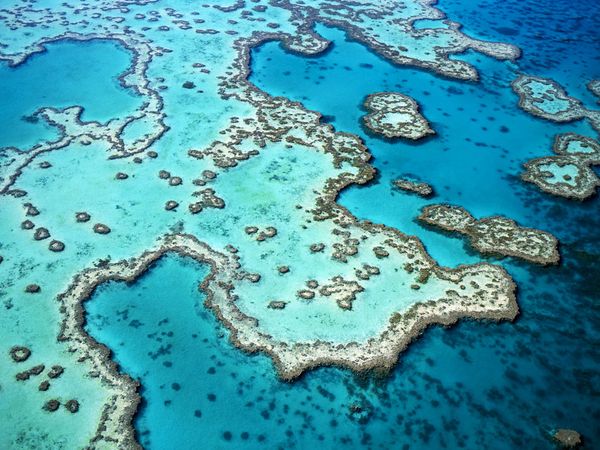
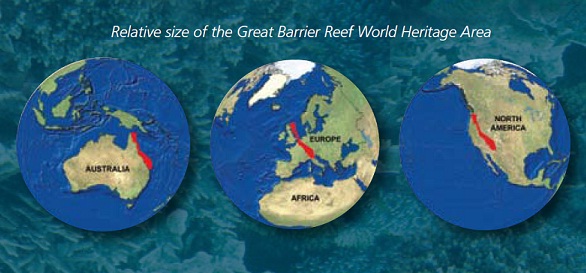
The Great Barrier Reef World Heritage Area covers an area of 348,000 square kilometres and more than 2300 kilometres long

Green activists are expecting to hear the results of investigation on the Great Barrier Reef conducted by the joint mission of the UNESCO World Heritage Centre (WHC) and the International Union for Conservation of Nature (IUCN). The experts visited Australia from March 4-14 to probe into the current park’s environmental conditions, including alleged man-made threats posed by seam gas exploration projects.

The Greenpeace is nearly completing a signup campaign of 15,000 people while GetUp! intensifies it drive to gather a strong 75,000 strong petition to stop developmental aggressions.

“Imagine if the Pyramids were being bulldozed or the Grand Canyon mined – the global community would be furious,” GetUp!, a major environmental activists, said  in an email loop.

GetUp! is trying to construct a simile to compare these World Heritage sites to Australia’s Great Barrier Reef.
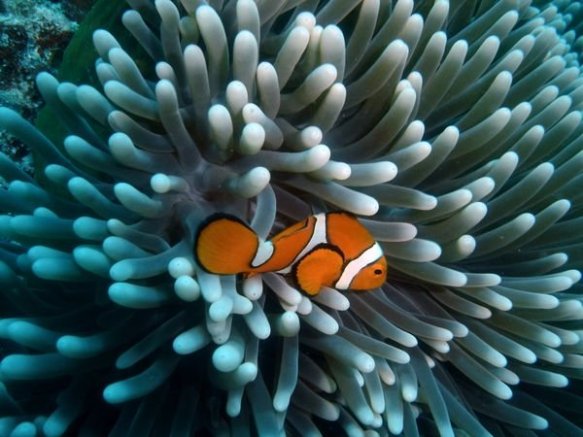
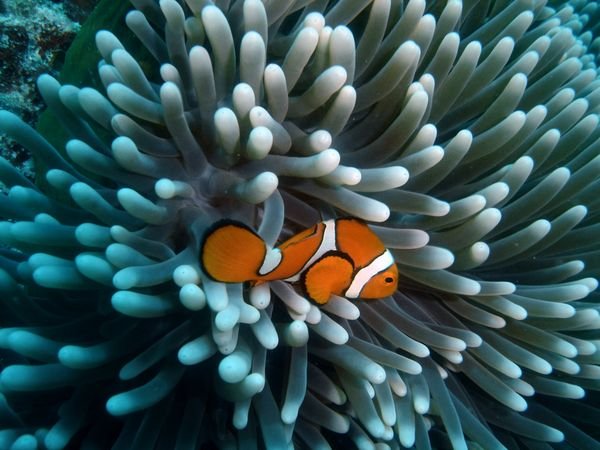
Beautiful marine lives under threat (Photo: National Geographic)

Earlier, the UN team has already warned the Great Barrier Reef is posed “to die a thousand cuts” with various threats including growing population, mining boom, and gas explorations.  The team also intended to re-assess the overall outstanding value of the reefs.

The Australian committee of the IUCN has warned of a tenfold increase in shipping on the World Heritage Site associated with existing and proposed port development projects. Much of it will be going through channels within a marine park far narrower than the English Channel, the Crickey claimed.

The Gladstone Ports Corporation (GPC) approved the project in 2011 allowing  private contractors “to dredge 46 million cubic metres from within the harbour boundaries,  inside the World Heritage area, over the next 20 years…a volume equivalent to 27 Melbourne Cricket Grounds,” GetUp! argued.
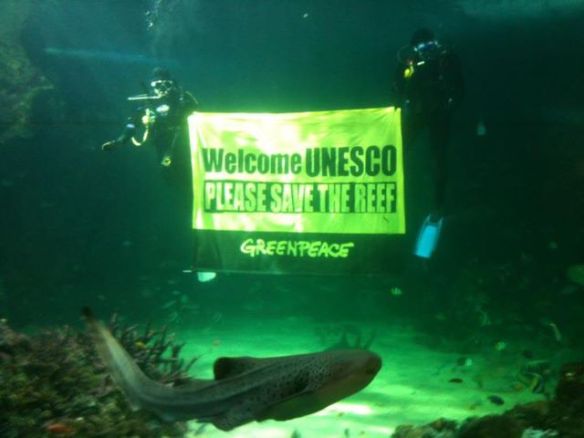
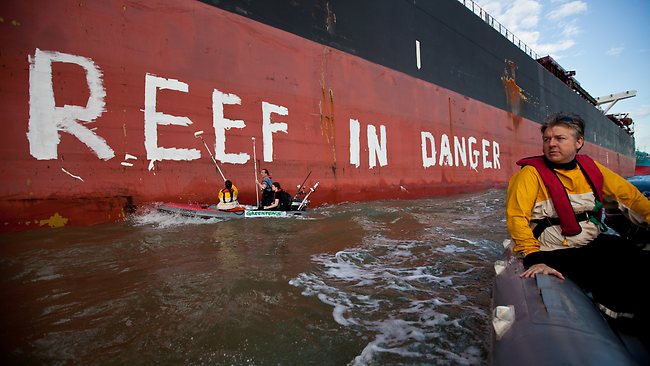
Greenpeace welcomes underwater investigation

 News reports claimed the Federal Government and the Queensland State Government approved the project amid strong protests from local residents. Further, they said the United Nations which holds custody to the Heritage Park was not consulted on the project which is a breach of World Heritage guidelines.

A private law firm for Gladstone commercial fishing businesses warned that the Western Basin Dredging and Disposal Project has significant long term environmental impacts on a national scale.

Ridiculous as it may sound, but the lawyer’s group said the massive dredging activities occurs 24 hours per day, 7 days per week, for about 18 months.  It is estimated that 42,300,000 cubic metres of material is to be dredged over the construction phase which cause turbidity plumes in the Port area. Contaminants are also speculated to spread in the Port area which can destroy the Port’s ecosystems.

The lawyers estimated that dredging will cause the direct loss of around 902 ha of benthic habitat (including 258.8 ha of seagrasses).  An additional 5416 ha of benthic habitat (including 1406 ha of seagrasses) may be indirectly lost in the short to medium term. In summary, the group said close to 1,700 hectares of seagrass will likely be lost and 6,300 hectares of benthic habitat likely to be lost.   There are additional obstructions of the northern Western Basin due to construction and increased vessel traffic, including massive dredges may impede the migratory pathways of marine fauna using The Narrows and the entire Port Curtis region, the lawyers claimed.
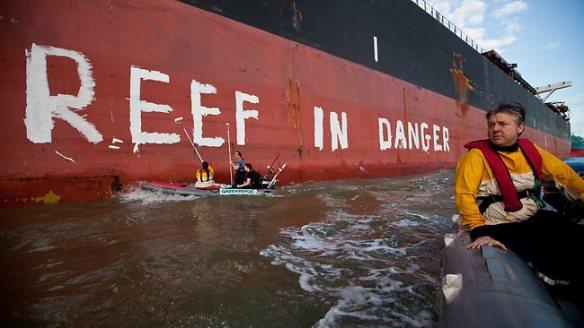
Greenpeace intensifies on-site campaign

In 2011, a three-week fishing ban was imposed around the Gladstone area after sightings of fishes infected by unknown disease. Barramundi, for instance, were reported to have suffered from ‘sore’ and ‘cloudy’ eyes, while other fish appeared deformed and had bruises

The project is a partnership venture between Santos, Petronas, Total, and KOGAS. Santos is Australia’s largest domestic gas producer while PETRONAS is Malaysia’s national oil and gas company and the second largest LNG producer in the world. French energy major, Total, on the other hand, is the world’s fifth largest publicly traded integrated international oil and gas company; and South Korea’s KOGAS is the world’s largest buyer of LNG.

The partners announced the Gladstone Liquified Natural Gas (GLNG) project creates more than 5000 jobs during construction and about 1000 ongoing positions in the operational phase. They added that the project stimulates businesses and employment opportunities in the Gladstone and Roma regions through increased demand for goods and services.

Santos builds a LNG export facility in Gladstone for commercialised QLD seam gas resources. The facility is expected to  produce 3-4 million tonnes per annum (Mtpa) of LNG with future potential expansion to nominal 10 Mpta. The project is consists of CSG field development; gas transmission pipeline construction; and LNG liquefaction and export facility development.

The facility – built on Curtis Island (Hamilton Point area) – is close to the industrial deepwater port of Gladstone. The Project sources gas from Santos CSG fields around the Comet Ridge and Roma project areas, with gas being transported to the Gladstone LNG facility via subsurface 425 km gas transmission pipeline. Santos is planned to drill and complete the development wells to supply 53000 petajoules (PJ) (140 billion3) of CSG to the proposed LNG facility. There are about 600 wells to be dug prior to 2015 and 1400 or more wells after 2015 (excluding exploration wells). Installation of related infrastructures are constructed including access roads, accommodation camps, water gathering networks, water management facilities, in-field gas gathering networks (to transport gas from the wells to the field compression stations, gas compression stations and pipeline compressor stations).
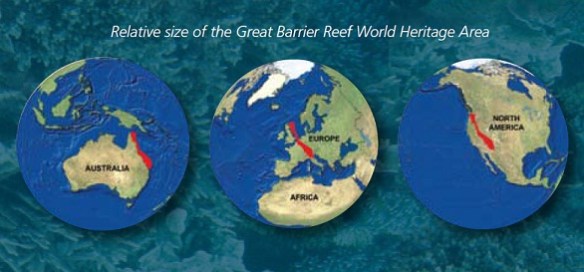
A comparative size on the Great Barrier Reef

The gas transmission corridor is 425 km long underground gas transmission pipeline corridor will accommodate one or more pipelines for the delivery of fas from the CSG resouces to the facilty. Transmission pipelines nominal diametere 650-800 mm.

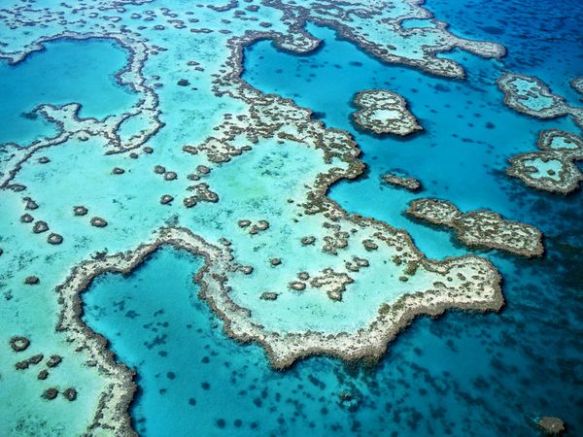
The Great Barrier Reef World Heritage Area covers an area of 348,000 square kilometres — the equivalent size of Italy or Japan, more than 2300 kilometres long. It extends to the low water mark on the mainland coast along northern Australia. It Includes more than 3000 separate coral reefs, some 900 islands and all the waters within the outer boundaries of the Marine Park.

It is designated as national park in 1975 and listed in the UNESCO world heritage list for its invaluable in 1981

The UN report will be presented to the World Heritage Committee in June, which will then decide whether to list the reef as a World Heritage Site in Danger.

News Link: Asian Correspondent