Australia Day focuses on Aborigines, refugees

This year’s Australia Day has seen both old and new issues come under the spotlight, including indigenous culture, asylum-seekers, gay marriage, and climate change.

These issues, however, cannot be solely discussed through political means but through the arts.

Prime Minister Julia Gillard poses with Geoffrey Rush

Academy-award winning actor Geoffrey Rush was named the 2012 Australian of the Year in a ceremony at the Parliament House, Canberra. In his acceptance speech, he urged Australians to consider the importance of arts to nurture and uplift the spirit of the nation. Rush spoke of urgent issues that affect the nation which can find solutions in the arts.

Rush says Australia is one of the oldest nations on earth where inspiration abounds. He noted that going back to the root of the nation through aboriginal history, culture and performing arts, Australians will be able to find “our dreaming” which leads to the heart of the nation’s being, the ABC quoted him in his speech.

The ABC added, “In the past, Australians of the year have used the spotlight to focus on social, political or environmental issues, but Rush does not see it as a automatic megaphone.” As a performing artist, the event is an opportunity to spotlight current issues through the arts.

SBS, a multicultural public broadcaster, also noted Rush of his support to local writers to write stories about people who come to Australia by boat.

“I put a call out to the writers of Australia, we’ve had a bumper year in television drama, people are starting to watch it in great numbers..I  would love a writer to write a fabulous great miniseries,” the SBS quoted him in his speech before reporters.

Six Australians are featured in the SBS documentary :Go Back to Where You Come From"

SBS has produced a documentary last year entitled Go Back to Where You Come From” which featured six Australian volunteers who were challenged to take part in an adventure to experience life as a refugee. The script took them to the local communities where refugees have settled down, then flash backward to the horrific journeys by sea, asylum-seeker camps, and to the tricky and dangerous places on earth. Featured places include refugee camps in Malaysia, war-torn Jordan, Iraq, and Congo. The mini-series has elicited various reactions from televiewers while Fairfax media lambasted the series claiming it as a story for the manipulated and gullible participants.

Rush is a stage and film actor. His first film Hoodwink was featured in 1981. He rose to global fame in 1996 with the film Shine for which he won an Oscar. More recently, he appeared on Munich, Pirates Of The Caribbean and The King’s Speech, for which he earned a BAFTA. Rush is an ambassador for the Melbourne Symphony Orchestra and UNICEF Australia, as well as patron of the Melbourne International Film Festival.

News Link: Asian Correspondent

Prosecute people smugglers, but how?

Shipwrecks will not deter refugees or asylum seekers to take the boat off to Australia- the metaphorical Utopia or Promise Land where people can play cricket or surf the net all day.

About 200 people or more from Arab countries, are feared dead at sea 200 km off Java Island of Indonesia when the overloaded boat they boarded sunk on Saturday. Only three dozens of survivors are so far accounted for, but do not rely on numbers which government statisticians can easily tweak. These people are reportedly come from Dubai and flew into Jakarta to be transported to Australia by boat.

A survivor wails after being rescued

Depending on which media you are reading, each Arab paid $500 each to Indonesian airport authorities and $6,000 each to board an Australian-bound boat. The Sydney Morning Herald’s Editorial wonders if the Indonesian authorities did not notice these Arab-looking people entering Jakarta without valid visas. Then all these desperate people queued on a port where they took the boat with a capacity of 100– there were 200 passengers.

The ABC reports that this latest tragedy costs over $600,000, a hefty amount which went into the pockets of people smugglers.

The boat captain and crew members are said to be safe. Before the boat sank, they grabbed their life vests and swam away.

Australian media say this exemplifies another well-organised people smuggling stirring further debates on Australia’s immigration policies.

This latest tragedy also coincides with the first death anniversary of about 50 asylum seekers who were shipwrecked on the stormy waters off Australia’s Christmas Island. Two weeks ago, another boat tragedy took place nearby.

A statistics from the Australian Parliament House shows that this year, 28 boats carrying 1675 people have been intercepted on Australian waters (as of June)– a sifnificant decrease from 124 boats loading 6879 people in 2010.

Earlier this year, the Julia Gillard Government approved the so-called Malaysian Solution, a policy to process asylum seekers offshore in exchange for the intake of genuine refugees. Gillard pinned hopes that this solution will stop people smuggling. The latest tragedy, however, proves she is wrong.

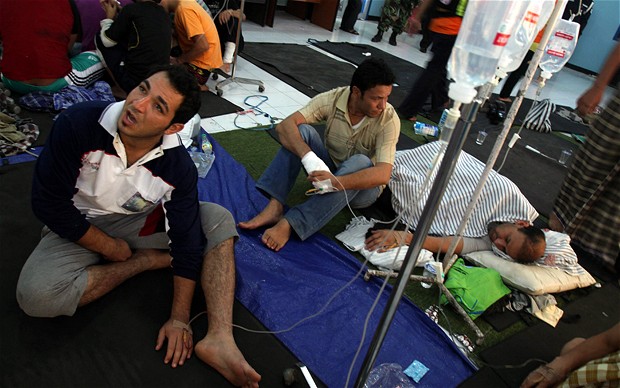
Other survivors receive treatment at a temporary shlter in Indonesia (Photo AFP Getty)

Time and again, boat tragedies tell stories of lost lives and broken dreams. News Limited reports an account of a survivor: 

Esmat Adine, 24, a Hazara refugee from Afghanistan said he “tried to find a suitable and legal way” but after being told he wouldn’t be eligible for a student visa to Deakin University until 2013 – and fearing for his life – he fled to Jakarta.

“I was arrested by the Taliban last year and imprisoned for 16 days where they beat me and made me sleep on a dead body,” he said.

“I registered with UNHCR in Jakarta who said it could take one year but I have a wife and three-month-old daughter at home and this is the quickest way.

“We had to go so we decided to go the quickest way. There are many, many people. They are waiting in Jakarta, waiting for the boat. Most of them, they are sure they will get to Australia.

Refugees and asylum seekers have nothing to lose and nowhere to go to. Adine was quoted further by News Ltd as saying, “If Australia does not accept our request now, we will do (it) again because we have nothing.”

If the inter-governmental solutions are not workable, can’t the governments arrest and prosecute human smugglers? They should, but how?

News Link: Asian Correspondent